
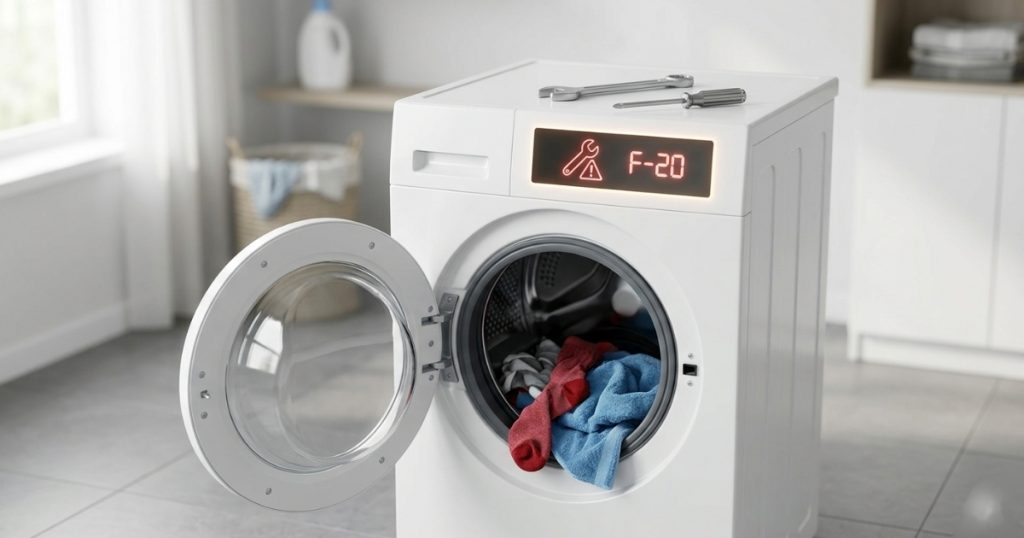
You’ve loaded your clothes, pressed start — and now your laundry is sitting in a tub of standing water because the drum refuses to spin. A washing machine not spinning is one of the most frustrating appliance problems, but the good news is that it’s often something you can fix yourself without calling a repair technician.
In this guide, we’ll walk you through the most common reasons your washer won’t spin and exactly what to do about each one.
Why Is My Washer Not Spinning?
Before you reach for your phone to call a repair service, it’s worth understanding what causes a washing machine to stop spinning. Most of the time, the problem falls into one of these categories:
- An unbalanced or overloaded drum
- A clogged or kinked drain hose
- A faulty lid switch or door latch
- A worn or broken drive belt
- A malfunctioning motor coupling
- A control board or timer issue
Quick tip: Always check the simplest explanations first — like an overloaded drum or a tripped error code — before disassembling anything.
Step-by-Step Fixes for a Washer That Won’t Spin
1: Check the load size
2: Inspect the drain hose
3: Test the lid/door latch
4: Check the drive belt
1. Balance and Reduce the Load
An unbalanced or overloaded drum is the single most common cause of a washing machine not spinning properly. Modern washers have built-in sensors that will pause or stop the spin cycle if they detect an imbalance — this is a safety feature, not a malfunction.
Fix: Open the door and redistribute the clothes evenly around the drum. Remove a few items if the load feels packed tight, then restart the spin cycle.
2. Inspect the Drain Hose and Filter
If your washer can’t drain water, it often refuses to spin as a protective measure. A kinked, clogged, or improperly positioned drain hose is a very common culprit.
- Pull the machine slightly away from the wall and check the hose at the back for bends or kinks.
- Check if the hose end is inserted more than 4–5 inches into the standpipe — too deep causes a siphon effect that prevents draining.
- Locate and clean the drain pump filter (usually behind a small panel at the front base of the machine).
3. Check the Lid Switch or Door Latch
Top-loading washers have a lid switch that must be engaged for the machine to spin. If it’s broken or stuck, the washer may fill and wash but refuse to enter the spin cycle. Similarly, front-loaders won’t spin if the door latch doesn’t click properly.
Fix: Open and firmly close the lid or door. Listen for a clear clicking sound. If the latch appears broken or the switch doesn’t respond, it will likely need to be replaced — a straightforward and inexpensive repair.
4. Inspect the Drive Belt
The drive belt connects the motor to the drum. Over time, it can stretch, slip, or snap entirely. If you can turn the drum by hand while the motor hums but the drum doesn’t move, a broken belt is likely the cause.
- Unplug the machine before inspecting.
- Remove the rear or front panel (depending on your model).
- Look for a rubber belt looped around the drum pulley and motor shaft.
- Replace if cracked, loose, or missing.
Safety first: Always unplug your washing machine from the power outlet before performing any internal inspection or repair.
5. Check the Motor Coupling (Top-Loaders)
On many top-loading washers, a plastic motor coupling connects the motor to the transmission. It’s designed to break under strain — acting like a fuse — to protect more expensive parts. If it’s broken, the motor will run but the drum won’t move at all.
Replacing a motor coupling is a moderately DIY-friendly repair, and the part itself is inexpensive.
6. Reset the Machine and Check for Error Codes
Sometimes the fix is as simple as resetting the washer. Unplug the machine from the wall, wait 60 seconds, then plug it back in. Many modern washers will also display an error code on their display panel — consult your model’s manual to decode what the number means.
When to Call a Professional
Most spin problems are DIY-fixable, but certain issues warrant a professional’s attention:
- Burnt smell or visible electrical damage
- The motor itself has failed
- Control board errors that persist after a reset
The transmission (in top-loaders) has seizedIf your washer is more than 10 years old and requires an expensive repair like a new motor or control board, it may be more cost-effective to replace the unit entirely.
A washer not spinning is almost always fixable — and in most cases, you won’t need to pay for a service call. Start with the basics: check your load size, inspect the drain hose, and test the door latch. If those don’t resolve the issue, work through the internal components like the drive belt and motor coupling.
A little troubleshooting goes a long way. If you found this guide helpful, share it with someone else facing the same laundry headache — or bookmark it for the next time your machine acts up.
Frequently Asked Questions
Why does my washer wash but not spin?
This is often caused by a broken lid switch, faulty door latch, or a drainage problem. When water can’t drain, most washers will refuse to start the spin cycle as a safety measure.
Can an unbalanced load stop a washer from spinning?
Yes — modern washing machines have sensors that will pause or abort the spin cycle if the load is too heavy on one side. Redistributing the laundry evenly usually solves the problem immediately.
How do I know if my washer’s drive belt is broken?
If you can easily spin the drum by hand while the motor is running (or the drum spins with no resistance when the machine is off), the drive belt is likely broken or has slipped off its pulley.
Is it worth repairing a washing machine that won’t spin?
It depends on the repair cost versus the machine’s age and value. As a general rule, if the repair costs more than 50% of the price of a new machine, replacing it is the smarter option.
How do I reset a washing machine that won’t spin?
Unplug the washer from the power outlet, wait at least 60 seconds, then plug it back in. This clears the control board’s memory and can resolve many electronic glitches causing spin failures.